THE SEED
A Reflection by Patrick Higgins
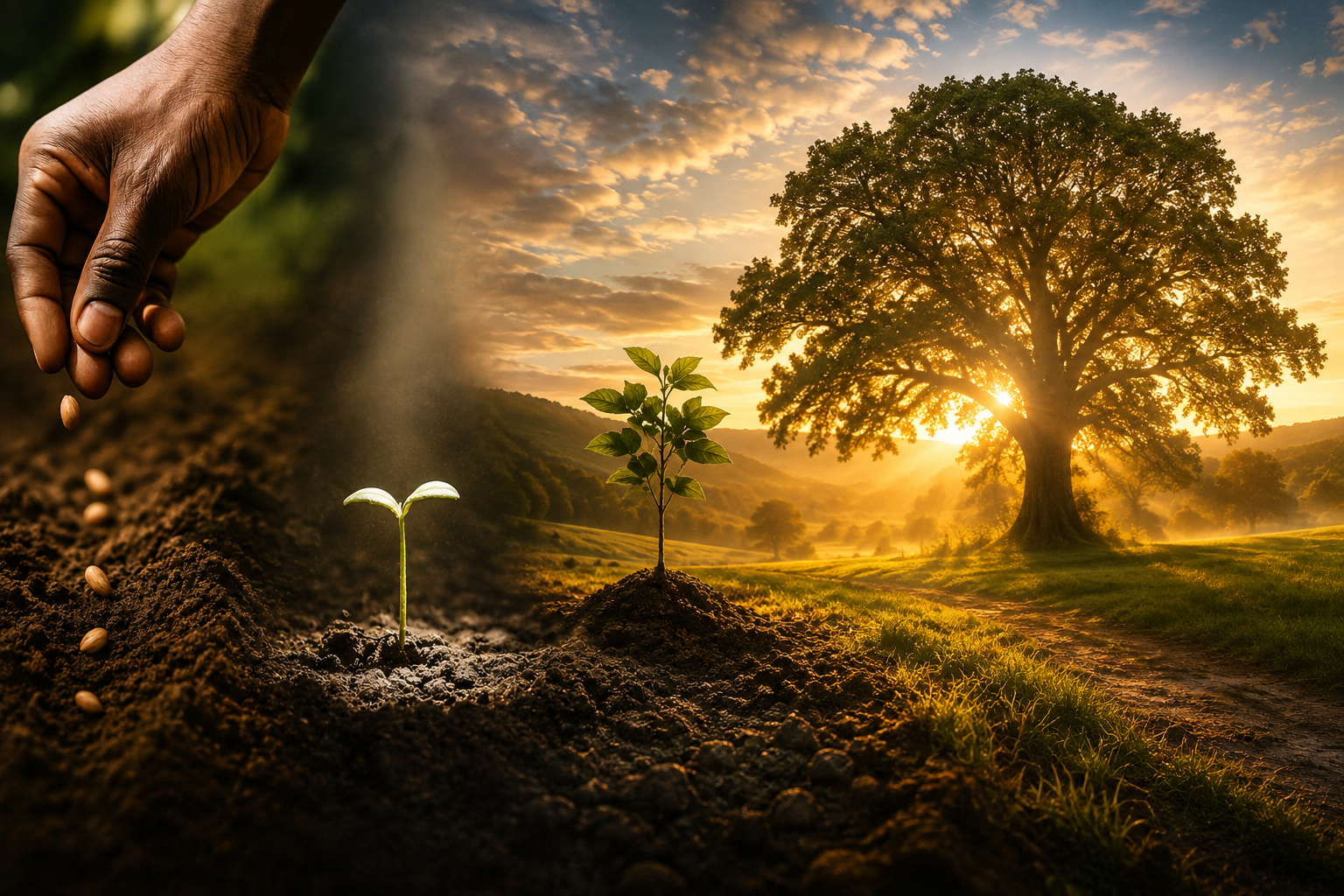
Few things in life appear less impressive than a seed. It fits comfortably in the palm of your hand—small, dry, and apparently lifeless. Yet hidden within that tiny shell is the potential to become something far greater than anyone might imagine.
Every majestic oak, every towering pine, every vineyard, every field of grain, and every garden bursting with color all began exactly the same way—as a single seed.
But perhaps the greatest lesson the seed teaches us is one we rarely stop to consider.
If it remains safely in a jar, on a shelf, or even in the palm of your hand, nothing happens. It never grows. It never changes. It never fulfills the purpose for which it was created.
Before new life can emerge, the seed must first be planted. Or, from another perspective, it must first be buried. On the surface, burial doesn’t look like success. If anything, it looks like the end of the road. Finality.
Yet from the gardener’s perspective, and more importantly, from God’s perspective, everything is unfolding exactly as it should.
For the miracle of life to unfold, the seed needs rich soil, rain, sunshine... and time. But even with those life-giving necessities, no one sees what is happening—not at first.
Long before anyone notices the first green shoot breaking through the soil, something remarkable has already been taking place where only God can see it. Hidden beneath the surface, embraced by the soil, life quietly begins.
The gardener doesn’t dig up the seed every morning to see if it’s growing. He waters it, tends it, then waits and trusts the process.
Consider the life of a tree.
A seed becomes roots. Roots become a sapling. The sapling becomes a tree.
The tree eventually blooms. The bloom produces fruit.
And what does that fruit contain?
More seeds.
The process never truly ends. Nor can it ever be hurried.
Every tree spends far more of its life growing than blooming. We admire the blossoms, enjoy the fruit, and benefit from its shade. But rarely do we stop to consider the years of quiet growth that made them possible.
The point to consider is this: the greatest transformations in life rarely announce themselves.
We live in a world that celebrates instant success, constant recognition, and visible accomplishments. Yet the seed reminds us that the most important work often happens long before anyone notices.
Every great accomplishment begins with a first step.
Every family has a beginning.
Every friendship begins somewhere.
Every act of kindness starts with a single decision.
Even the mightiest forests began with seeds no larger than those we can hold in our hands.
It should not surprise us that Jesus often spoke about seeds.
On one occasion, He compared the kingdom of Heaven to a mustard seed. Though tiny and seemingly insignificant, it grows into something far greater than anyone might imagine.
On another occasion, He spoke of seeds falling upon different kinds of soil, reminding us that the condition of the heart often determines what will ultimately grow.
The “seeds” Christ spoke of in these parables pointed toward matters of faith, salvation, and the condition of the human heart.
The simple truth is that not all seeds are planted in the dirt of a garden. God wove this “seed” principle throughout His creation.
Once they are planted, seeds have an incredible way of finding a path forward.
Seeds push through darkness toward the light.
Seeds grow around obstacles instead of surrendering to them.
Seeds patiently become what they were created to be.
A kind word can plant a seed that lifts a discouraged heart.
Friendship seeds begin with a simple conversation.
Marriage seeds begin when two people are willing to say, “I do.”
Families are built one life, one lesson, and one generation at a time.
Teachers plant seeds to encourage struggling students.
Coaches plant seeds by believing in young athletes before they believe in themselves.
Neighbors plant seeds by extending helping hands.
Businesses use seed money to grow their companies.
A single seed of forgiveness can restore a broken relationship.
Some of the seeds we plant grow more quickly than others.
Some require many years before they bear anything of significance.
Some bear fruit far beyond what we ever expected.
Other seeds continue changing lives long after we’ve forgotten we ever planted them.
Tragically, not every seed we plant produces something good. Some seeds produce bitterness. Some produce division. Some produce resentment, anger, or unforgiveness. And some, if left unchecked, can grow into consequences far more destructive than we ever imagined.
In conclusion, we are always sowing. Some seeds produce life. Some produce destruction. And eventually, we reap what we sow.
So… the next time you hold a seed in your hand—physical or metaphorical—you should pause for just a moment, then ask: “What am I sowing today that I may not want to reap tomorrow?”
Because tomorrow’s harvest often begins with today’s choices.
The good news is this: if you don’t like the harvest you may eventually reap from the bad seeds you are sowing today, the solution is glaringly obvious—start planting the seeds you can be proud of when harvesttime comes.
Know what I mean?